D-mannose for UTIs, what it is and what the best trial found
A simple sugar with a tidy theory behind it and a disappointing headline result. What D-mannose is, how it is supposed to work, what the largest placebo controlled trial showed, and why it never replaces antibiotics for an active infection.
By the Wet Betty editors · Published Oct 17, 2026
Fact checked against FDA 510(k) filings, WHO guidance and the sources listed below. How we review
D-mannose is a simple sugar sold as a supplement to prevent urinary tract infections. The theory is that it stops E. coli from sticking to the bladder wall. But the largest placebo controlled trial, MERIT, published in 2024, found it did not reduce recurrent UTIs in women. It never treats an active UTI. That needs a clinician.
What D-mannose is.
D-mannose is a sugar, a close chemical relative of glucose. Small amounts are found in most diets, and the body uses it in normal metabolism. As a supplement it is sold as a powder you dissolve in water or as capsules. It is not a drug, so it is not reviewed for effectiveness before it is sold.
How it is supposed to work.
Most UTIs are caused by E. coli, bacteria that normally live in the bowel. To cause an infection, they have to stick to the cells lining the urinary tract.
The idea behind the supplement is a decoy. D-mannose in the urine blocks E. coli from attaching to those cells, so the bacteria get flushed out the next time you pee. The 2022 Cochrane review describes this anti-adhesive effect as well established in the lab. The open question was always whether it prevents real infections in real people.
What the evidence says.
| Study | What it was | What it found |
|---|---|---|
| Cochrane review, 2022 | Seven small trials, 719 people, no two comparable | Little to no evidence to support or refute D-mannose; very low certainty |
| MERIT, JAMA Internal Medicine, 2024 | Double blind, placebo controlled, 598 women, 99 UK practices, six months | No meaningful reduction in UTIs versus placebo |
Before 2024. A handful of small trials, several from specialist clinics, looked encouraging. The Cochrane review, published in 2022, examined them and found the evidence poor: most trials were at high or unclear risk of bias, none could be combined, and the certainty was rated very low. Its authors asked for one well designed placebo controlled trial.
MERIT. That trial came from the University of Oxford and was published in JAMA Internal Medicine in 2024. Researchers enrolled 598 women, average age 58, who had at least two UTIs in six months or three in a year. Half took D-mannose powder daily and half took an identical looking placebo, for six months. Neither the women nor the researchers knew who got what.
The result: 51.0 percent of the D-mannose group and 55.7 percent of the placebo group went to a clinician with a suspected UTI. That gap was not statistically significant, and none of the secondary measures, including antibiotic use and symptom days, differed either. The authors concluded that D-mannose should not be recommended to prevent recurrent UTIs in this group.
What that does and does not mean. MERIT studied women in primary care, with an average age of 58. It did not test D-mannose for an active infection, in men, in children, or after surgery. So it does not close every door. It does mean the strongest evidence we have points to no meaningful benefit for the most common reason people buy it.
Who might still try it.
Some people with recurrent UTIs, and some clinicians, still consider it, because it is inexpensive, side effects are mild and the alternatives each have trade offs. The NHS still lists it as something people buy to try to prevent UTIs. If you go that way, go in with clear eyes: the best trial says it probably will not change how many infections you get. Track your UTIs so you and your clinician can judge honestly.
Talk to a clinician first if you have diabetes, since it is a sugar, if you are pregnant, or if you take other medicines. Follow the product's label and your clinician.
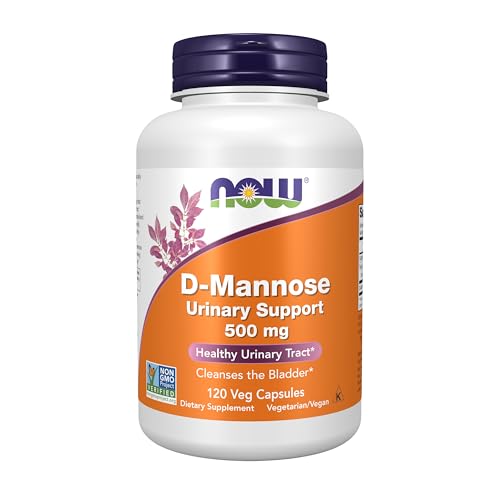
Pros
- Plain formula, no added herbs
- Low cost per dose
- Widely available
Cons
- Evidence for prevention is mixed
- Not a treatment for an active UTI
| Category | Format | Brand |
|---|---|---|
| Vaginal health | 120 capsules | NOW Foods |
Our take. A simple, third party tested D-mannose capsule at a fair price.
Why it never replaces antibiotics.
An active UTI is a bacterial infection, and the NHS notes there is no evidence D-mannose eases symptoms or treats one that has already started. Left untreated, a bladder infection can climb to the kidneys. Cleveland Clinic notes that antibiotics treat most UTIs, that most people feel better within a few days of starting them, and that a UTI with fever, chills, nausea or vomiting may need stronger treatment. Antibiotics are something a clinician may prescribe after a quick check.
What has better evidence for prevention.
Prevention has no single magic answer, but there is more to work with than a supplement. Peeing soon after sex, drinking enough fluid, and choosing a lube that does not irritate are the low cost moves, covered in can lube cause a UTI. After menopause, Cleveland Clinic notes a clinician may suggest a vaginal estrogen cream to help lower UTI risk. For frequent infections, a clinician may also discuss preventive antibiotics or other prescription options. These are decisions for an appointment.
When to see a clinician.
See a clinician any time you have UTI symptoms: burning when you pee, needing to go often or urgently, cloudy or bloody urine, or lower belly pain. Get care the same day for fever, chills, back or side pain, nausea or vomiting, if you are pregnant, or if symptoms come back soon after treatment. If you get UTIs often, ask about a prevention plan rather than trying supplements alone. This page is general information, not medical advice.
Frequently asked questions.
What is D-mannose?
A simple sugar, a close relative of glucose, sold as a supplement. It is thought to work in the urine, by stopping E. coli from sticking to the bladder wall so the bacteria are flushed out when you pee.
Does D-mannose work for UTIs?
The best evidence says probably not, at least for prevention. The MERIT trial, the largest placebo controlled study, found no meaningful reduction in UTIs over six months in women with recurrent infections. Earlier positive studies were smaller and less rigorous.
Can D-mannose cure a UTI without antibiotics?
No. There is no good evidence it treats an active infection, and an untreated UTI can spread to the kidneys. If you have UTI symptoms, see a clinician.
Is D-mannose safe?
Trials report few side effects, and none serious; the Cochrane review lists mostly diarrhea and vaginal burning. It is a sugar, so people with diabetes should ask their clinician first. Ask before using it in pregnancy, too.
Is D-mannose better than cranberry?
Neither is a sure thing. Cleveland Clinic notes that cranberry extract supplements may lower the chance of a UTI, though grocery store cranberry juice does not prevent one. For recurrent UTIs, a clinician can lay out the prescription and non prescription options that have stronger evidence.